
FROM THE DAWGHOUSE…
What is Dispensationalism and Covenant Theology?
Forge Men are asking good questions!
File this blog in your theology file for both of these topics are in the category of How Do
I Understand the Big Picture of the Bible, Genesis to Revelation?
I’ll explain them individually and then give you some resources to do some research on your own.
I’m always interested in how AI explains things, wondering if it skews Christian topics in a wrong direction. In both of the AI definitions, they were about right on:
AI on Dispensationalism:
Dispensationalism is a theological system, primarily within Christianity, that interprets biblical history as divided into distinct periods called dispensations, each characterized by a unique way God relates to humanity. It emphasizes a literal interpretation of the Bible, particularly Old Testament prophecies, and often includes a premillennial eschatology, believing Christ will return before a literal 1,000-year reign on Earth. A core tenet is the distinction between the church and Israel, with Israel maintaining a unique and future role in God’s plan.
Quite frankly that’s right on. Here’s the chart I have used for years to teach my future elders and deacons what Dispensationalism is:

Now here’s AI on Covenant Theology:
Covenant theology is a framework for interpreting the Bible that emphasizes the concept of covenants as the organizing principle for understanding God’s relationship with humanity throughout history. It views the Bible as unfolding through a series of covenants, including the Covenant of Redemption, the Covenant of Works, and the Covenant of Grace, which find their ultimate fulfillment in Jesus Christ.
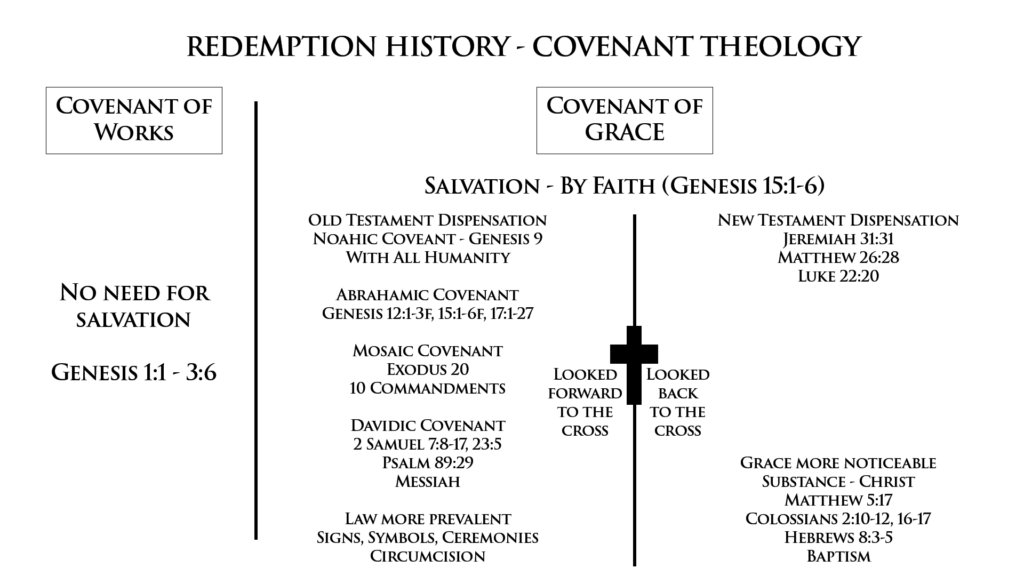
Again, spot on. Now let me give you some of my convictions about each system.
- The Dispensational System above was how the original founders of this thinking first articulated dividing up the Bible. Dispensational thinkers today (primarily from Dallas Theological Seminary) have moved away from this original 7 Dispensation scheme to more of a 3 Dispensation model due to critiques from evangelical Biblical scholarship over the 1900’s to the present.
- I was raised on the Dispensational System in the churches I grew up in and it still serves in general as a major influential interpretative guide for many Christians in non-denominational, Baptist and many other evangelical denominations. While it claims to be the most literal model of Biblical interpretation, I believe that in fact it does not fully take into consideration the unfolding of Biblical Revelation in the New Testament and unjustly criticizes other views as being non-literal, and thus not faithful to Scripture.
- Dispensationalism’s greatest flaw is believing that that there are two people of God and therefore they have a confused eschatology (view of the end times) which postulates that there must be an earthly reign of Christ with a restored national Israel.
- The word “dispensation” is used only 4 times in the KJV version of the Bible and never is found in the ESV, but the KJV word “dispensation” is translated “stewardship” or “plan” in the ESV.
Resource: Death of The Church Victorious, Tracing the Roots and Implications of Modern Dispensationalism, by Ovid E. Need Jr. Offers in my view a devastating critique not only on the origins of Dispensationalism, but how as a system it leads the church to false conclusions as to its true identity as well as to a false eschatology concerning national Israel.
- Covenant Theology in my opinion is the stronger way to approach the Bible. The Word “Covenant” is found in the Bible 280 times in the KJV and 316 times in the ESV. We see from sheer numbers that “covenant” is the larger concept in the Bible as well as the oldest idea in the Bible and in Church history that shapes how the entire Bible is even set up and is to be understood. Thus, we have the Old Testament/Covenant and the New Testament/Covenant, which is really one Covenant of Grace with two periods of time, or two dispensations of time.
- Covenant Theology helps us to see that God established a Gracious Covenant with Abraham in Genesis 12, 15, 17 and that Jesus perfectly fulfills it. All of the Old Testament looks ahead and finds its true fulfillment in Jesus Christ. The Israel or People of God in the Old Testament are transformed in the NT to the Church, consisting of Jew and Gentile.
- Covenant Theology clearly shows how the Church of Jesus Christ is the true Israel of God in our time. Want to check it out? Read Ephesians 2, and see my blog on How Should Christian View the Modern State of Israel?
In conclusion: This brief sketch of two major evangelical systems which have impacted Christianity over the past many years should provoke us to study deeper the Word of God and as men following Christ seek to understand these deeper concepts. We should have open and respectful dialogue with those who differ with us, realizing that we have far more in common by our united focus on Jesus Christ as risen Savior and Lord than with those who deny our Lord and reject a high view of the Bible. Still, we should continually be growing and learning men! We all are and should be lifelong theologians and Bible students! We must all follow Paul’s admonition to young Timothy:
Do your best to present yourself to God as one approved, a worker who has no need to be ashamed, rightly handling the word of truth. 2 Timothy 2:15 ESV
Continue to FORGE a deeper grasp of God’s Word to us! Be a workman! Your leadership and influence will be enhanced by deeper knowledge.
You take it to heart!
Pete Alwinson
Resources:
The Christ of the Covenants –Paperback December 22, 1987 by O. Palmer Robertson (Author)
Introducing Covenant Theology –Paperback April 1, 2009 by Michael Horton (Author)
Understanding Dispensationalists-Vern S. Poythress, 1994